
A public outreach program
Saint-Denis and its 87,000 inhabitants-28% of who have nationalities other than French-is a town of contrasts, a multicultural suburban town partway between memory and modernity. In a place where new construction and urban development have erased the shape of the ancient town, the inhabitants often lack points of reference-either spatial or temporal.
Archaeology is a concrete discipline, perfectly suited for establishing direct contact with the general public. Since 1988, archaeology in Saint-Denis has forged a solid link between the territory and its inhabitants by developing a public outreach program entitled "Archaeology, Territory and Citizenship". The goal of the program is to transform "archaeological material" into tools for understanding the territory as well as into products created on this same territory. The former are used as mediation support, the latter are designed to develop economic activity.
Tools for understanding a territory
The first approach mentioned above aims at encouraging all those who live and work in Saint-Denis-both children and adults-to discover their urban roots, and to appropriate a territory for themselves and to find reference points to be able to read the town. To do this, the Archaeological Service makes use of its research focused on training about the territory based on its archaeological network. The Service uses an inexhaustible fund of scientific material to create teaching workshops, and to invent tools for reading the urban space. These include a Historic Walking Tour from the Basilica to the Stade de France, the Changeable Model of the Territory, and temporary reference points such as the Path Back into Time from the Site of the 2,000 Rods.
These actions, which have received the support of a number of institutions, often have an urban, experimental dimension, taking place in housing projects, outlying neighborhoods and in the public space in the town center. They include "open-house excavations", participation in "European Heritage Days" and the "artisans' village", and each is designed to be a rendez-vous with the local population.
Promoting heritage development
The second part of the public outreach program takes advantage of an amazing resource-the vast amount of documentation that has been gathered over the years. The creation in 1981 of the archaeology galleries in the Art and History Museum, was the first step in putting this research into the public eye.
A recent project consisted of combining technical questions and studies on archaeological objects with the know-how of artisans working in the area. It involved demonstrations by craftspeople and demonstrations of experimental archaeology as well as using local actors to raise the public's awareness of the potential that this heritage-both tangible and intangible-represents.
The non-profit association "Franciade, le goût de la connaissance" was created to develop these aspects.
The Saint-Denis Archaeological Service is part of a heritage development project that plays a role in local development.
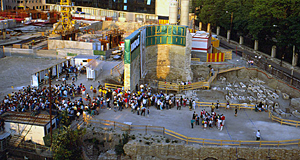
Open house to mark the end of excavations on the necropolis in 1990.
© UASD / E. Jacquot.